




- What Exactly Is CRM? A Simple Explanation
- Why Small Businesses Can't Afford to Ignore CRM
- Unpacking the Core Components of a CRM System
- Avosist: Your AI-Powered CRM for Omnichannel Engagement
- Choosing the Right CRM for Your Business: A Practical Checklist
- Frequently Asked Questions About CRM for Small Businesses
- Conclusion: CRM isn't a Luxury, It's a Necessity for Growth
Automate your WhatsApp sales with Avosist AI
Create accountAre you struggling to manage customer interactions, keep track of leads, or personalize your outreach? For many small and medium businesses, customer data often lives in scattered spreadsheets, email inboxes, and chat histories, leading to missed opportunities and frustrated customers. It's time to bring order to the chaos and boost your customer relationships.
The solution you need is Customer Relationship Management (CRM). But if terms like "CRM software" sound intimidating, don't worry. This plain-English guide will demystify CRM, explain its core benefits, and show you how a smart platform like Avosist can transform your customer engagement, especially across popular channels like WhatsApp.
What Exactly Is CRM? A Simple Explanation
💡 Definition: CRM, or Customer Relationship Management, is a technology system for managing all your company's relationships and interactions with customers and potential customers. The goal is simple: improve business relationships to grow your business.
Think of CRM as a central hub for everything related to your customers. Instead of customer information being siloed in different departments or scattered across various tools, a CRM system gathers it all in one place. This includes contact details, purchase history, communication records (emails, calls, chat messages), customer service interactions, and even social media activity.
The ultimate purpose of CRM is to help businesses:
- Understand Customers Better: Get a complete 360-degree view of each customer.
- Improve Customer Service: Provide faster, more personalized, and consistent support.
- Streamline Sales Processes: Track leads, manage sales pipelines, and automate follow-ups.
- Enhance Marketing Campaigns: Target the right customers with the right messages at the right time.
- Boost Customer Retention: Build stronger, long-lasting relationships that encourage loyalty.
In essence, CRM helps you manage the entire customer journey, from initial contact to post-sale support, ensuring a smooth and efficient experience for both your business and your customers.
Why Small Businesses Can't Afford to Ignore CRM
Many small businesses believe CRM is only for large enterprises. This couldn't be further from the truth! In fact, SMBs often benefit the most from CRM because they have fewer resources and every customer relationship counts. Without a CRM, small businesses frequently face:
- ⚠️ Lost Leads: Contact details or follow-up tasks get forgotten.
- ⚠️ Inconsistent Communication: Different team members might give conflicting information.
- ⚠️ Lack of Personalization: Generic messages that don't resonate with customers.
- ⚠️ Inefficient Sales Process: Manually tracking leads is time-consuming and prone to errors.
- ⚠️ Poor Customer Retention: Difficulty identifying at-risk customers or nurturing loyal ones.
Implementing a CRM system can turn these challenges into opportunities. Studies show that CRM can significantly impact key business metrics:
Businesses using CRM report an average sales increase of 27% due to better lead management.
CRM can improve customer retention rates by up to 34% through personalized interactions.
Sales productivity can rise by 39% as CRM automates administrative tasks.
Customer service satisfaction improves by 45% with quick access to customer history.
These aren't just numbers; they represent tangible growth and efficiency for your business. For more insights into how CRM can specifically benefit your small business, you can read our comprehensive guide: CRM Nedir? Küçük İşletmeler İçin Kapsamlı CRM Rehberi 2026 (Note: This link is from the provided list, which has a Turkish slug but is a valid internal blog link for CRM topic).
Unpacking the Core Components of a CRM System
While every CRM system has unique features, most share a common set of functionalities designed to manage different aspects of customer relationships. Here are the fundamental components you should expect:
- Contact Management: The bedrock of any CRM. This feature stores all customer information—names, contact details, company, communication history, preferences, and more—in a centralized, easily accessible database. It ensures everyone on your team has the most up-to-date information.
- Lead Management: Helps you track potential customers (leads) from their initial inquiry through the entire sales pipeline. It allows you to qualify leads, assign them to sales reps, and monitor their progress, ensuring no lead falls through the cracks. This is crucial for effective lead generation.
- Sales Automation: Automates repetitive sales tasks like sending follow-up emails, scheduling appointments, or generating quotes. This frees up your sales team to focus on selling, not administration. For a deeper dive, check out our guide on Sales Automation: How to Close More Deals with Less Effort.
- Marketing Automation: Enables you to create, manage, and track marketing campaigns. This includes email marketing, SMS campaigns, and even WhatsApp bulk messaging, allowing for targeted outreach and personalized communication based on customer segments.
- Customer Service & Support: Manages customer inquiries, service requests, and issues. It ensures customer problems are addressed promptly and efficiently, often through ticketing systems, knowledge bases, and live chat.
- Analytics & Reporting: Provides insights into sales performance, marketing campaign effectiveness, customer behavior, and service metrics. These reports help you make data-driven decisions to optimize your strategies.
- Customer Segmentation: Allows you to group customers based on specific criteria (e.g., purchase history, demographics, engagement level). This is vital for personalized marketing and service. Learn more about Customer Segmentation.
Traditional CRM vs. AI-Powered CRM: What's the Difference?
| Feature/Aspect | Traditional CRM | AI-Powered CRM (e.g., Avosist) |
|---|---|---|
| Data Entry | Mostly manual, time-consuming. | Automated data capture, smart suggestions, less manual input. |
| Lead Scoring | Rule-based, requires manual setup. | Predictive, uses machine learning to identify high-potential leads automatically. |
| Customer Interaction | Primarily human-driven, reactive. | Proactive, automated responses via chatbots, personalized recommendations. |
| Personalization | Basic segmentation, manual tailoring. | Dynamic, real-time personalization based on behavior and history. |
| Analytics | Descriptive reports, historical data. | Predictive analytics, actionable insights, future trend forecasting. |
| Efficiency | Improves efficiency by centralization. | 🚀 Significantly boosts efficiency through intelligent automation and insights. |
💡 Key takeaway: While traditional CRM organizes your data, AI-powered CRM actively works with your data, providing insights and automating actions to drive growth.
Avosist: Your AI-Powered CRM for Omnichannel Engagement
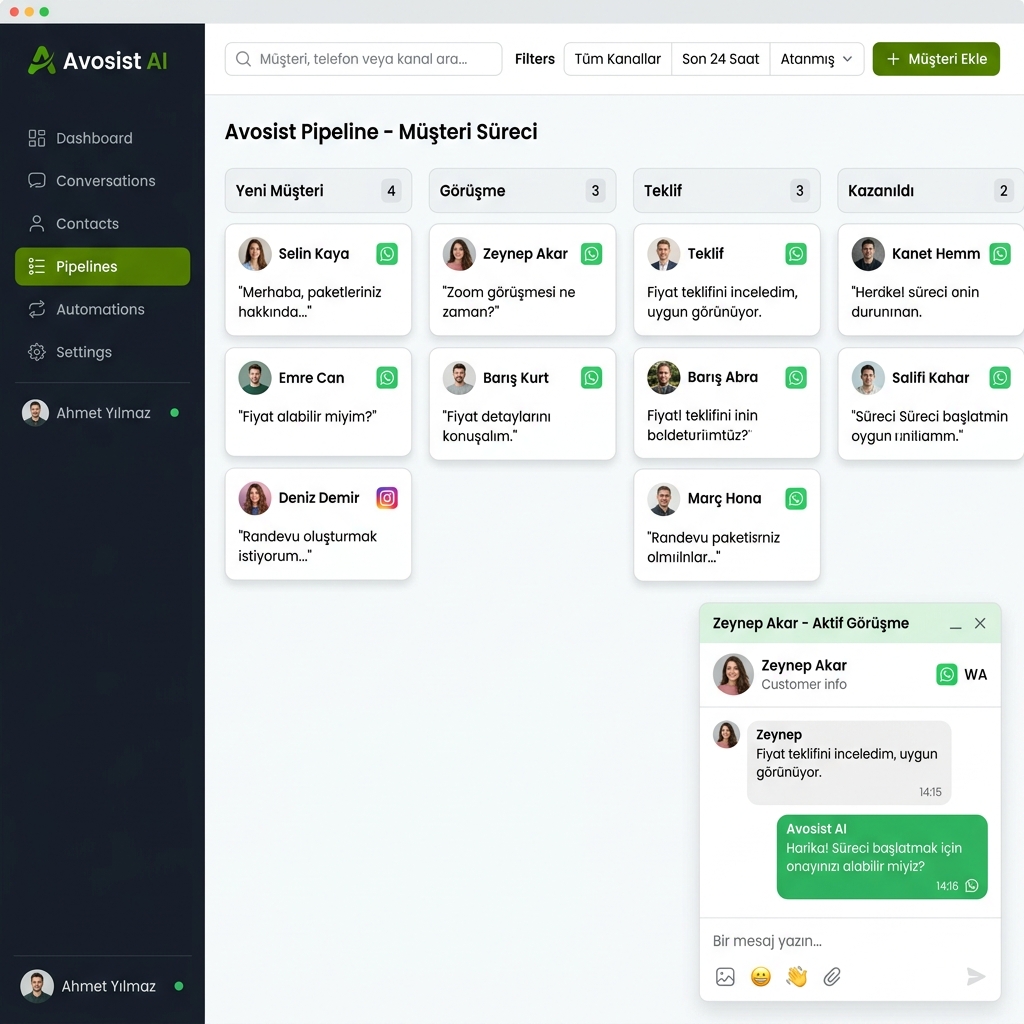
This is where platforms like Avosist truly shine. Avosist isn't just a CRM; it's an omnichannel AI assistant platform that integrates CRM functionalities with advanced AI automation, specifically designed for modern businesses leveraging instant messaging channels like WhatsApp, Instagram, and Messenger, alongside voice.
With Avosist, you get the robust data management of a CRM combined with the intelligence and automation of AI. Here's how Avosist acts as your smart, AI-powered CRM:
AI Assistant & Chatbots
Automate interactions across WhatsApp, Instagram DMs, and Facebook Messenger. Our AI handles FAQs, qualifies leads, and provides instant support 24/7, ensuring no customer query goes unanswered.
Centralized Customer Profiles
All interactions from every channel are consolidated into a single customer profile. Get a complete view of conversation history, preferences, and purchase intent instantly.
Automated Lead Generation & Nurturing
Capture leads directly from chat, qualify them with AI, and automate personalized follow-up sequences to move them down the sales funnel. This transforms passive chats into active sales opportunities.
Smart Customer Segmentation
Automatically segment your audience based on their behavior, interests, and interaction history. This allows for highly targeted marketing campaigns and personalized service, improving engagement and conversion rates.
Appointment Reminders & Management
Automate appointment scheduling and reminders through chat, reducing no-shows and improving operational efficiency.
Campaign Management
Run targeted WhatsApp marketing campaigns to specific customer segments, announcing promotions, new products, or important updates directly to their preferred messaging app.
Avosist empowers your team by automating routine tasks, providing instant access to customer insights, and enabling hyper-personalized communication at scale. It's designed to be intuitive, requiring no technical skills to set up and manage.
💡 Avosist Advantage: Combine the power of CRM with omnichannel AI automation to engage customers where they are, when they need you most.
Ready to Simplify Your Customer Relationships?
Experience the power of an AI-powered CRM that works across all your customer channels. Get started with Avosist today and see how easy it is to manage leads, automate interactions, and delight your customers.
Try Your Free Sales Assistant →Choosing the Right CRM for Your Business: A Practical Checklist
Selecting a CRM can feel overwhelming, but by focusing on a few key criteria, you can find the perfect fit for your business needs:
- Ease of Use: A CRM should simplify your life, not complicate it. Look for an intuitive interface that your team can quickly adopt without extensive training.
- Key Features: Does it have the core components you need (contact management, lead tracking, automation)? If you rely heavily on messaging apps, an AI WhatsApp assistant integration is crucial.
- Scalability: Can the CRM grow with your business? Ensure it can handle increasing customer data and team members as you expand.
- Integrations: Does it integrate with your existing tools (e.g., email marketing platforms, e-commerce stores, calendar apps)? Seamless integration prevents data silos.
- Cost-Effectiveness: Evaluate the pricing structure. Does it offer a good return on investment for your budget? Many platforms, like Avosist, offer free trials or tiered pricing plans.
- Support: What kind of customer support is available? Reliable support can be invaluable when you have questions or encounter issues.
For small businesses, an AI-powered omnichannel solution like Avosist offers exceptional value. It's designed to be user-friendly, highly scalable, and rich in features that directly address the challenges of modern customer engagement, particularly for businesses operating in dynamic digital environments.
Frequently Asked Questions About CRM for Small Businesses
What is the most basic function of a CRM?
The most basic function of a CRM is contact management. It centralizes all your customer and prospect information, making it easy to access details like names, contact numbers, emails, and interaction history in one place.
Can a small business really benefit from CRM?
Absolutely! Small businesses often benefit immensely from CRM. It helps them organize customer data, automate routine tasks, improve lead management, provide personalized customer service, and ultimately grow sales without needing a large team. It's about working smarter, not harder.
Is CRM expensive for small businesses?
Not necessarily. Many CRM providers, including Avosist, offer flexible pricing plans, free trials, or even free tiers designed specifically for small businesses. The cost often depends on the features you need and the number of users. The ROI often far outweighs the investment.
How quickly can I see results from implementing a CRM?
The speed of results can vary, but many businesses report improvements in efficiency and lead management within weeks of implementation. Significant impacts on sales and customer satisfaction typically become apparent within a few months, especially with consistent use and training.
What's the difference between CRM and marketing automation?
CRM focuses on managing all aspects of customer relationships, including sales, service, and marketing data. Marketing automation is a component often found within CRM (or integrated with it) that specifically automates marketing tasks like email campaigns, social media posting, and lead nurturing to improve efficiency and lead conversion.
Conclusion: CRM isn't a Luxury, It's a Necessity for Growth
For any business, big or small, customer relationships are the lifeblood of growth. A CRM system provides the structure, insights, and automation needed to nurture these relationships effectively.
- CRM demystified: It's a central system to manage all customer interactions and data, designed to improve relationships and grow your business.
- Essential for SMBs: CRM helps small businesses overcome challenges like lost leads, inconsistent communication, and inefficient processes, leading to higher sales and retention.
- AI is the future: AI-powered CRMs like Avosist go beyond data organization, offering predictive insights, intelligent automation, and omnichannel engagement across platforms like WhatsApp.
- Smart choice: When choosing a CRM, prioritize ease of use, relevant features, scalability, and seamless integrations.
Don't let valuable customer data slip through the cracks or miss out on opportunities to connect deeply with your audience. Embrace the power of CRM, especially when supercharged by AI, and watch your business thrive.
Ready to Transform Your Customer Relationships?
Start your journey with Avosist's AI-powered omnichannel CRM today. No technical skills required, just smarter customer management.
Create Your Free Account →